
Amman Conference to Launch Regional Task Force to Combat Cultural Racketeering

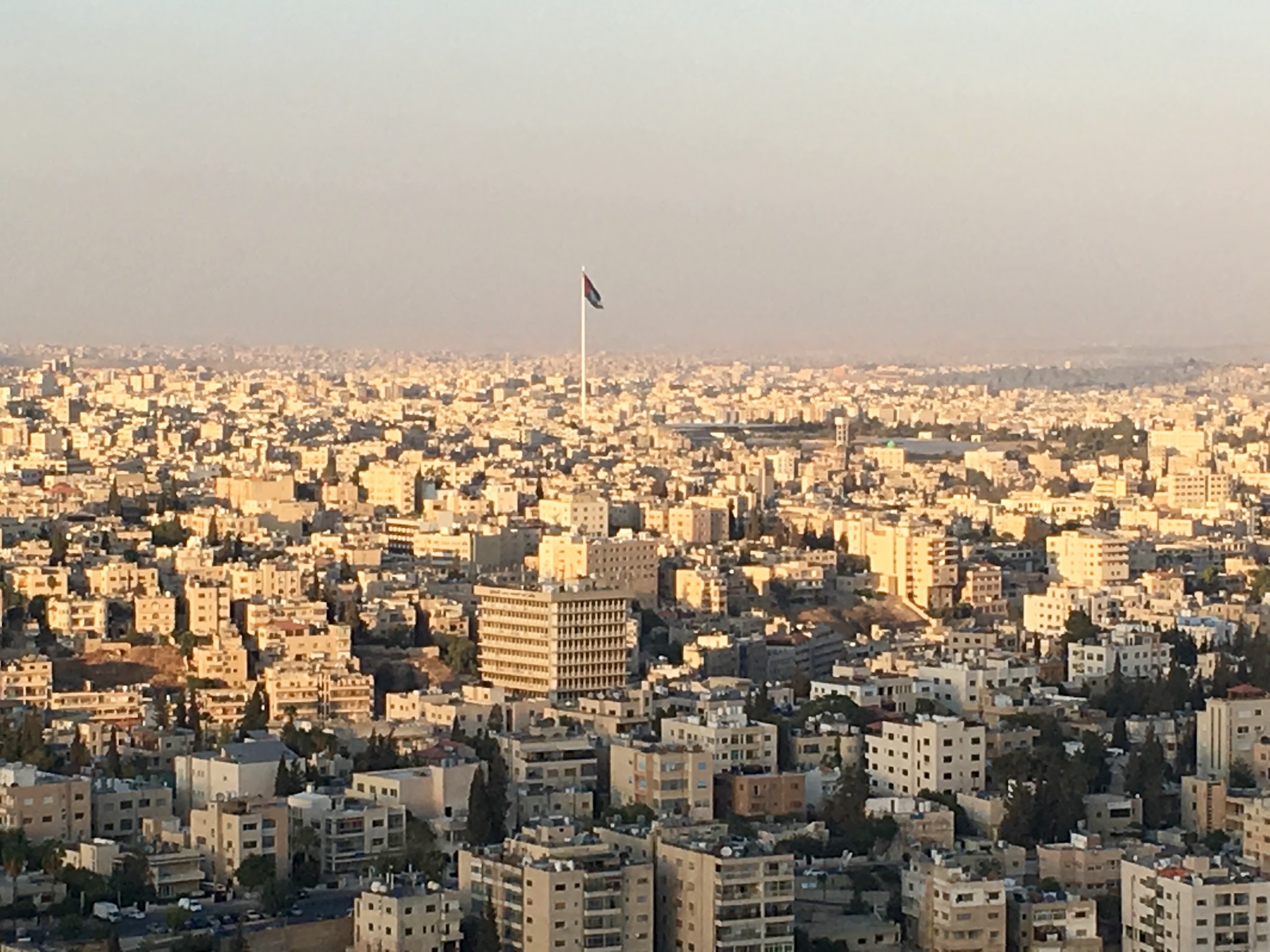
2016-09-06(Amman, Jordan)—Under the patronage of the Deputy Prime Minister and Minister of Foreign Affairs and Expatriates, His Excellency Nasser Judeh, the second annual #CultureUnderThreat regional conference will be held in Amman, Jordan on September 8, 2016 to advance cooperation between Arab countries in the fight against the illegal smuggling and sale of cultural artifacts from the region.
The opening and closing sessions of this conference are on the record and open to the media. Please contact info.conf@fm.gov.jo to register to attend. More information about the conference is available online at theantiquitiescoalition.org/jordan2016.

The conference will be hosted by the Government of the Hashemite Kingdom of Jordan, the Antiquities Coalition, and Middle East Institute (MEI), and will bring together ministers from 17 Arab League nations.

Her Excellency Lina Annab, Minister of Tourism and Antiquities, will head the proceedings. These regional leaders will coordinate actions to address the threat to cultural heritage emanating from antiquities looting, trafficking, and destruction by looters, criminals, and terrorist groups.

In addition, the Task Force Against Cultural Racketeering, consisting of government representatives from each country, will hold its inaugural meeting to finalize an action plan for the upcoming year on specific actions to be taken in this joint effort.

This historic event builds upon the Cairo Declaration released in 2015, in which ministers from 10 key Arab countries agreed to take steps to combat cultural crimes, and a follow-up high level forum held in September during the 70th session of United Nations General Assembly.

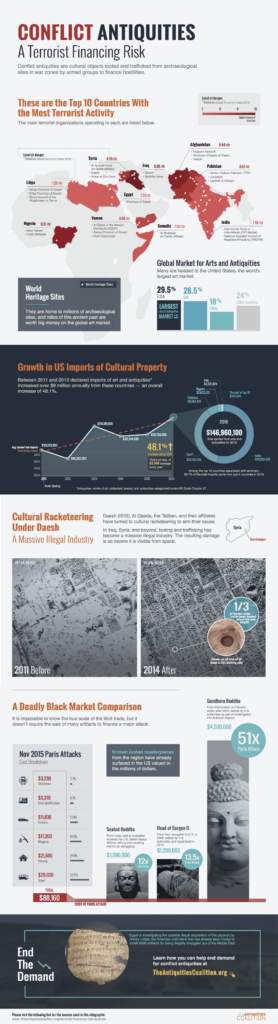
Cultural racketeering has increasingly become a financing tool for criminal and terrorist groups. Archaeological, historic, and religious sites are still at risk from armed conflict, targeted destruction, and organized plunder. Criminal and terrorist groups, such as Daesh, have earned several million dollars from cultural racketeering, which is being used to fund their operations. Arab countries agree on the need to cut off all sources of criminal and terrorist financing activities, including those originating from blood antiquities.

Heritage in the Headlines During UNGA

It was a headline week for the protection of cultural heritage.

When leaders from more than 160 countries gathered in New York City last week for the 70th Session of the United Nations General Assembly (UNGA), a main topic of discussion for the attending heads of state was how to combat the growing strength of violent extremist groups in the Middle East.

Critical to this effort is cutting off all possible sources of funding that support terrorist organizations such as ISIS. While Al Qaeda depended on donations from rich benefactors, ISIS has robbed, extorted, and kidnapped its way to becoming one of the wealthiest terrorist networks in history. The looting and trafficking of antiquities has played a key part in this economic strategy, while the destruction of cultural, historic, and religious sites has had the added “benefit” of further terrorizing the civilian population.

This past week, UNGA served as a platform for bringing together the key players from leading countries, international organizations, and law enforcement agencies, as well as the arts and archaeological communities, in a series of conferences to seek innovative solutions to halt the trafficking of “blood antiquities.” Never before has there been this level of political will from the global community in seeking real answers to this cultural, economic, and security crisis. The world is now on notice that buying or selling blood antiquities — especially when the proceeds can support terrorist causes — will no longer be tolerated.

On September 24, with our partners the Asia Society, Middle East Institute, and UNESCO, the Antiquities Coalition was proud to host a solutions-oriented forum with the Foreign Ministers of Iraq, Jordan, Egypt and Australia, in addition to senior delegations from Cambodia, Italy, Qatar, Saudi Arabia, and Thailand. This unprecedented gathering brought together policymakers and leading experts to develop and implement recommendations for halting this black trade. From this event, we are now spearheading the #CultureUnderThreat Task Force, comprised of law enforcement agents, business leaders, anti-terrorism experts, as well representatives from the arts and antiquities communities. This group will work to raise awareness about the linkages between the cultural racketeering and terrorist financing, close down markets to blood antiquities, and provide in country support to those who are risking their lives to protect our shared heritage. The task force will publish a set of recommendations before the end of the year and work with key stakeholders to realize their implementation.

Three days later on September 27, the United Nations also launched a new initiative, chaired by the Foreign Ministers of Jordan and Italy, with strong support from UNESCO, the U.N. Office of Drugs and Crime, and Interpol. This initiative aims to strengthen the political determination of member countries to take the necessary steps to shut down the illicit trade. The five partners have committed to a multifaceted campaign focusing on three aspects:

  • Preventing the destruction and illicit trafficking of cultural property
  • Interdicting the transit and transfer of cultural property
  • Cutting off financing of organized crime and terrorism

The Antiquities Coalition is honored to be working with Italy, Jordan, and the United Nations on this important effort.

As a special guest, Fatou Bensouda, the Prosecutor of the International Criminal Court (ICC), joined the proceedings by video to announce the arrest of Ahmad Al Faqi Al Mahdi, a senior member of the Ansar Dine, a terrorist group with connections to Al-Qaeda. He is charged with the intentional destruction of religious and/or historical monuments in Mali. This case sets a precedent as the first time that destruction of heritage is being treated as a crime of war by the ICC.

This event was followed on September 29 by another major program, in which the State Department, brought together law enforcement officials from the FBI, UNODC, and the Department of Homeland Security at the Metropolitan Museum. For the first time, U.S. law enforcement provided extensive (and recently declassified) evidence of how ISIS is benefitting from the trafficking of antiquities. The extremist organization is actively promoting plunder for profit by granting permits for new digs and taxing the sales, as well as raiding archaeological sites, museums and warehouses. These officials confirmed that the United States is one of the largest markets for these blood antiquities.

Even more importantly, they put the arts community on notice that the federal government is cracking down on illicit sales, and will take severe action against those that are knowingly supporting terrorism through the purchase of blood antiquities.

Heads of state also reconfirmed their commitment to fighting against the intentional destruction and trafficking of heritage. As part of the Leaders’ Summit on Countering ISIL and Violent Extremism, members reiterated their support for cutting off sources of funding for extremist groups. The development of an informal Public-Private Partnership to protect antiquities in Syria and Iraq was also announced, although details are limited on the partnership at this stage.

Lastly, no greater authority than Pope Francis, the unparalleled star of the past week, noted in his speech before the United Nations,

“…regarding to the painful situation of the entire Middle East North Africa and other African countries where Christians together with other cultural or ethnic groups and even members of the majority religion who have no desire to be caught up in hatred and folly have been forced to witness the destruction of their places of worship their cultural and religious heritage their houses and property and have faced the alternative either of fleeing or of paying for their adhesion to good and to peace by their own lives or by enslavement.”

Political will to take action is one of the critical elements to successfully halt the trafficking of blood antiquities. A significant step forward has been taken this week in raising the profile on this heinous crime – as well as some initial steps towards cracking down on those who allow it to continue. The Antiquities Coalition is inspired by this week’s progress, but there is still a significant challenge ahead of us in bringing a halt to this activity. We encourage all of you to join us in this fight in any way that you can. And please don’t buy blood antiquities.

Please sign our Call to Action

Cultural Property Advisory Committee (CPAC) hearing on Egypt’s MoU request for US import restrictions to combat the looting of Egyptian antiquities

The Antiquities Coalition strongly supports the request of the Egyptian government for the United States to provide additional protections against the import of illicit Egyptian antiquities.  We urge the Cultural Property Advisory Committee to the State Department to make a swift determination based on the clear evidence that Egypt meets the necessary criteria for accepting such a request, as well as the dire situation Egypt is facing in protecting its antiquities during its time of political transition.

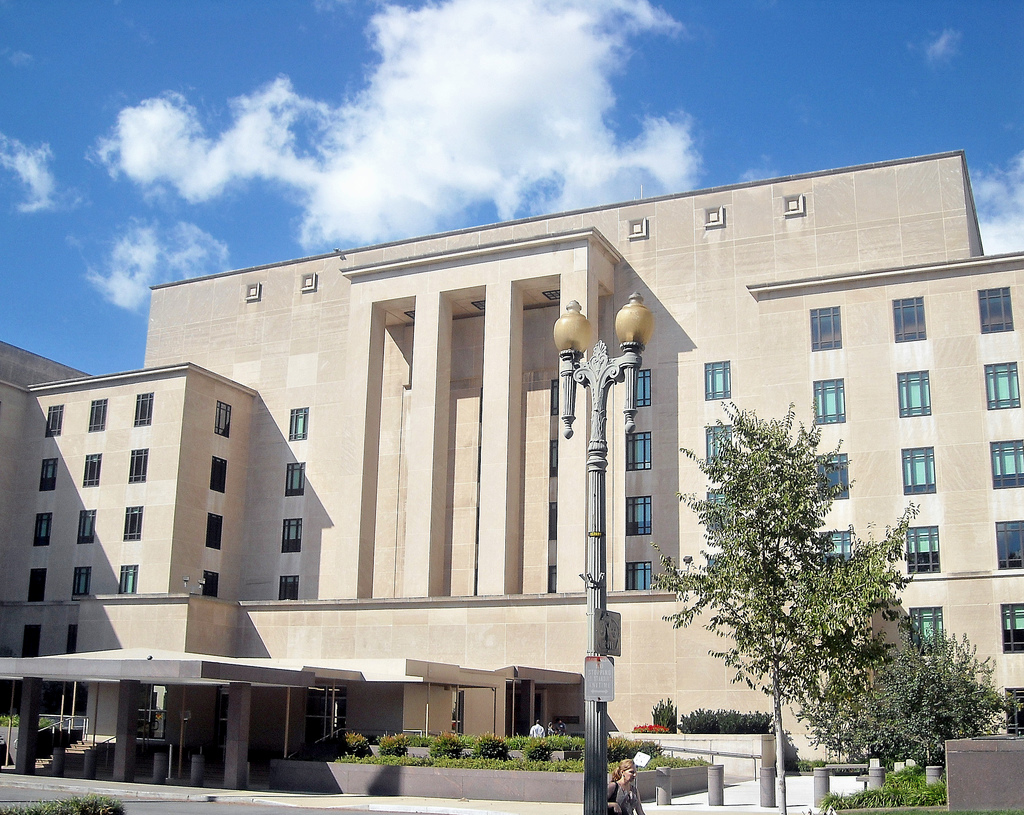
United_States_Department_of_State_headquartersOn June 2, The Cultural Property Advisory Committee to the U.S. State Department held a public hearing to consider the Egyptian government’s request for a bilateral Cultural Heritage memorandum of understanding (MOU). The Egyptian government requested this MOU to help in its battle against the rise of cultural racketeering – the systematic looting of antiquities by organized crime – since the January 2011.  If the Advisory Committee recommends that State accept Egypt’s request, State can direct the US Customs to halt the import of Egyptian antiquities without the proper documentation.

Monica Hanna, founder of the Egypt’s Heritage Task Force, traveled from Cairo to voice her support for this important initiative.  Her photos and personal account of the rapid and significant looting of sites across Egypt tell a tale of immense crisis.  Sarah Parcak, Associate Professor of Anthropology at the University of Alabama/Birmingham, shared that looting has increased at major archaeological sites by 500-1000% based on her analysis of satellite imagery done in association with the Antiquities   And Brian Daniels, Director of Research and Programs at the University of Pennsylvania’s Cultural Heritage Center, commented on the work of the Egyptian government in fighting against cultural racketeering.  Dr. Daniels addressed the fact that the 12,000 guards hired to protect sites by the Egyptian government is not an insignificant number and emphasized that event during the periods of turmoil Egypt the Egyptian government has sent guards and police resources to protect sites.

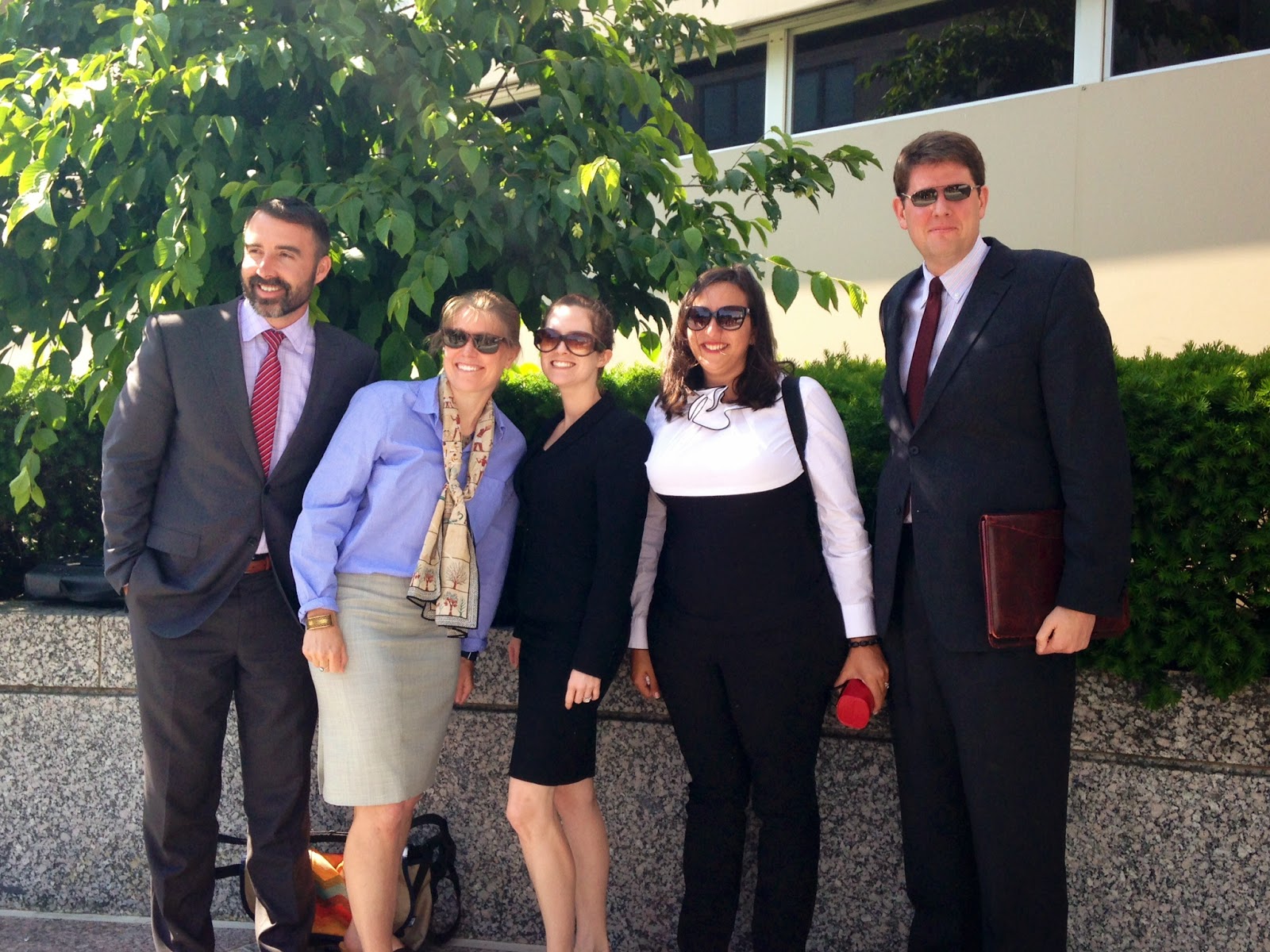
Speakers in favor of MoU for import restrictions on illicit antiquities. Left to Right: Douglas Boin; Sarah Parcak; Elizabeth Varner; Monica Hanna; Brian Daniels (Photo Credit: Katie Paul, The Antiquities Coalition)
Speakers in favor of MoU for import restrictions on illicit
antiquities. Left to Right: Douglas Boin; Sarah Parcak;
Elizabeth Varner; Monica Hanna; Brian Daniels
(Photo Credit: Katie Paul, The Antiquities Coalition)

Opposition to the MOU came primarily from Numismatists.  Representatives of the industry did not disagree with the basic requests of the Egyptian government, but strongly opposed the including of coins as part of the MOU. They allege that it is difficult to ensure that “small antiquities” including coins have the appropriate paperwork to ensure that they were obtained legitimately.  Lack of paperwork complicates or even blocks the import of these antiquities.

We look to Secretary Kerry to be a modern day “Monuments Men” in taking seriously the crime of cultural racketeering, starting with the rapid conclusion of a strong and meaningful cultural heritage MOU with Egypt. Conclusion of this agreement will provide a foundation for cooperation in protecting our common heritage. But more important, it signifies that the United States is prepared to take a leadership role in actively supporting countries across the globe – Egypt, Iraq, Syria, Peru, Guatemala, China, Cambodia and many more – in their fight to protect our common heritage.  Cultural racketeering is a global crisis that requires a global solution. It provides an opportunity to build on the United States’ legacy from WWII and continue fight against those attempting to erase our past to eradicate our future.

The Cultural Property Advisory Committee (CPAC) of the US Department of State is chaired by Prof. Patty Gerstenblith of the DePaul College of Law, and consists of members representing museums, archaeology, the international sale of cultural property, and the general public.

Full list of Speakers at Egypt MoU Public Hearing on June 2, 2014 

In favor of MoU: 

Dr. David O’Connor, Lila Acheson Wallace Professor of Ancient Egyptian Art, Institute of Fine Arts, New York University – at hearing to represent American Research Centre in Egypt (ARCE)

Dr. Laurel Bestock, Vartan Gregorian Assistant Professor of Archaeology and the Ancient World and Egyptology and Ancient Western Asian Studies – at hearing to represent American Research Centre in Egypt (ARCE)

Dr. Douglas Boin, Assistant Professor, St. Louis University Art History Department

Elizabeth Varner, President-Elect, Board of Directors, Lawyers’ Committee for Cultural Heritage Preservation, Executive Director, National Art Museum of Sport – at hearing to represent Lawyers’ Committee for Cultural Heritage Preservation (LCCHP)

Dr. Carmen Arnold-Biucchi, Ancient Coins Curator, Harvard Art Museums

Dr. Monica Hanna, Egyptologist, American University of Cairo; Founder of Egypt’s Heritage Task Force
**NOTE: Dr. Hanna was the only Egyptian on the panel during the public hearing and provided a significant amount of on the ground photo evidence (much of this can be found online at Egypt’s Heritage Task Force) 

Dr. Sarah Parcak, Associate Professor of Anthropology at the University of Alabama at Birmingham; Society for American Archaeology; The Antiquities Coalition and International Coalition to Protect Egyptian Antiquities ‘ICPEA’ – at hearing to represent Society for American Archaeology (SAA) and The Antiquities Coalition

Dr. Brian Daniels, Director of Research and Programs, Penn Cultural Heritage Center and Society for American Archaeology – at hearing to represent Penn Cultural Heritage Center and Society for American Archeology (SAA)

Opposed to MoU: 

Alan Safani, Art Dealer, International Association of Dealers in Ancient Art (IADAA)
**NOTE: Mr. Safani publicly supports the MoU but only in the case of newly surfaced illicit materials from Egypt 

Peter Tompa, Lobbyist, International Association of Professional Numismatists (“IAPN”) and the Professional Numismatists Guild – at hearing to represent International Association of Professional Numismatists (“IAPN”)

Mr. Wayne Sayles, Founder, Ancient Coin Collectors Guild – at hearing to represent Ancient Coin Collectors Guild

AC Efforts to Support Egypt Cited in New York Times

The New York Times documents Egypt’s request for the United States to impose emergency restrictions on the importing of Egyptian antiquities. The article cites the AC’s efforts to support Egypt’s request.

A wide-ranging group of experts who support Egypt’s bid for restrictions, among them historians, archaeologists, cultural heritage lawyers and security consultants, met with Dr. Ali at his embassy on Wednesday to discuss Egypt’s plight. Several of them, members of the Antiquities Coalition, a research group, said there was no question that stolen Egyptian relics are appearing for sale on websites and in dealers’ catalogs in the United States.

Read the full article here.

Crime and Conflict: Temple Looting in Cambodia

Davis, T. and Mackenzie, S. (2014) ‘Crime and Conflict: Temple Looting in Cambodia’. In J. Kila and M. Balcells (eds) Cultural Property Crimes: an overview and analysis on contemporary perspectives and trends (Brill: Leiden) 292–306.

As we are seeing now with the “Arab Spring,” and have seen throughout history, cultural destruction is often a handmaiden to conflict. In the Southeast Asian nation of Cambodia, fighting erupted between government forces and the communist Khmer Rouge in 1970 and did not end until the 1998 death of Pol Pot and subsequent surrender of his remaining forces. While contemporary accounts and photographs confirm the country’s ancient Hindu and Buddhist temples were largely intact before the war, most were then cut off from the outside world for decades, and some remain difficult and even dangerous to reach today due to poor roads, jungles, land mines, and unexploded ordnance (uxo). It is thus only now becoming possible to systematically investigate the wartime plunder of Cambodia’s antiquities, an undertaking that is growing more important each year as the country steps up efforts to recover its stolen treasures from overseas collections.

Cambodia is internationally celebrated for the twelfth-century ruins of Angkor Wat, the crowning achievement of the Khmer Empire, which ruled much of Southeast Asia from the ninth to fijifteenth centuries. But this temple— said to be the largest religious monument in the world—is just one of many in the country. While only the size of the us state of Oklahoma, Cambodia boasts 4,000 known prehistoric and historic sites, with more discovered each year (mocfa, 2013). But despite a long tradition of archaeology dating back to the French colonial era (1867–1953), only a fraction has been thoroughly surveyed, and even fewer scientifically excavated. So when looters reach them first, the only evidence of theft is often an empty hole in the ground, or an empty space on a temple wall. Calculating how many antiquities have been stolen and their value is thus very difficult.

Book available here.

CAI Chairman Interviewed for AnthroNotes

Deborah Lehr, Chairman of the Capitol Archaeological Institute (CAI) at George Washington University, and Dr. Eric Cline, Director of the CAI, joined AnthroNotes for an interview on the CAI’s efforts to fight cultural racketeering.

After seeing the Egyptian people stand up to protect the Cairo Museum against the looters, we believed our Institute, whose mission is to view archaeology as a tool of diplomacy, needed to take action. – Deborah Lehr

Read the full interview here.