

U.S. Embassy Hosts Regional Workshop on Combating Cultural Property Trafficking

Manila, May 13, 2026The U.S. Embassy in the Philippines convened law enforcement officials and cultural heritage specialists from ASEAN member states for the workshop “Combating Cultural Property Trafficking in Southeast Asia” held from May 5 to 8 at the Ayala Museum in Makati City.   Funded by the U.S. Department of State and hosted in the Philippines during its ASEAN Chair Year, this program strengthens the national security of the United States and ASEAN member states by enhancing regional cooperation to disrupt criminal networks and terrorist organizations that steal and sell artifacts to finance organized crime and criminal activities. 

“When cultural objects are stolen, communities lose part of their history and identity.  Cultural property trafficking is closely tied to transnational organized crime, and in some cases, to terrorist financing.  Groups like ISIS have used the sale of antiquities to generate revenue, turning cultural heritage into a tool for violence and instability,” U.S. Embassy Chargé d’Affaires, a.i., Y. Robert Ewing said in his opening remarks.  “Strong relationships between investigators, prosecutors, and cultural experts are essential.  The United States stands with ASEAN partners in this effort.  Together, we can disrupt these networks and protect the cultural heritage that defines this region,” he added. 

Throughout the four-day workshop implemented by U.S. non-profit organization Antiquities Coalition, 20 participants from across Southeast Asia learned about the scope and complexity of cultural property trafficking in the region; the links between antiquities trafficking and financial crimes; approaches to strengthen coordination across agencies within their governments; and how to engage international, regional, and national legal instruments that govern the protection of cultural property. 

Antiquities Coalition Executive Director Tess Davis warned that cultural trafficking persists due to the art market’s global reach, high value, and weak regulation.  “This is not a problem any country can solve alone.  This trade harms cultural heritage, local communities, and national economies,” Davis said.  “That is why partnership between the United States and ASEAN matters so much.  It is fitting that we are gathered in a country whose cultural heritage is among the richest in the region.” 

Representatives from the U.S. Department of State, Federal Bureau of Investigation, Customs and Border Protection, and Homeland Security Investigations presented American approaches to investigating and prosecuting cultural property crimes.  They highlighted the value of Cultural Property Agreements—bilateral agreements between the United States and partner countries that prevent trafficked artifacts from entering the United States. 

By the end of the workshop, participants examined their respective countries’ cultural heritage protection frameworks and developed a roadmap for sustained cooperation between ASEAN nations, the United States, and other stakeholders to combat the illicit antiquities trade. 

This workshop builds on a high-level U.S.-ASEAN meeting on cooperation to combat cultural property trafficking held in Jakarta in April and aligns with U.S. efforts to secure Cultural Property Agreements with countries across the region.  The issue spans all three pillars of the ASEAN Community—socio-cultural, economic, and security—making U.S.-ASEAN cooperation essential to safeguarding cultural heritage, protecting tourism and local economies, and strengthening regional security. 

Criminal syndicates and terrorist organizations generate millions of dollars by looting temples, archaeological sites, and museums across the world, then selling stolen objects on the international market to finance terrorist groups and organized crime—the same networks that engage in drug trafficking, money laundering, and armed conflict.  U.S. law enforcement has led global efforts in this fight, recovering over 2,500 trafficked items between 2011 and 2023 tied to the Kapoor network and valued at more than $143 million, and securing the largest-ever forfeiture of $12 million tied to trafficker Douglas Latchford, whose activities affected countries across Southeast Asia.
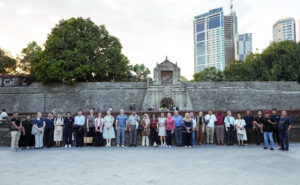
Press Release by U.S. Embassy in Manila, accessible at https://ph.usembassy.gov/u-s-embassy-hosts-regional-workshop-on-combating-cultural-property-trafficking/.
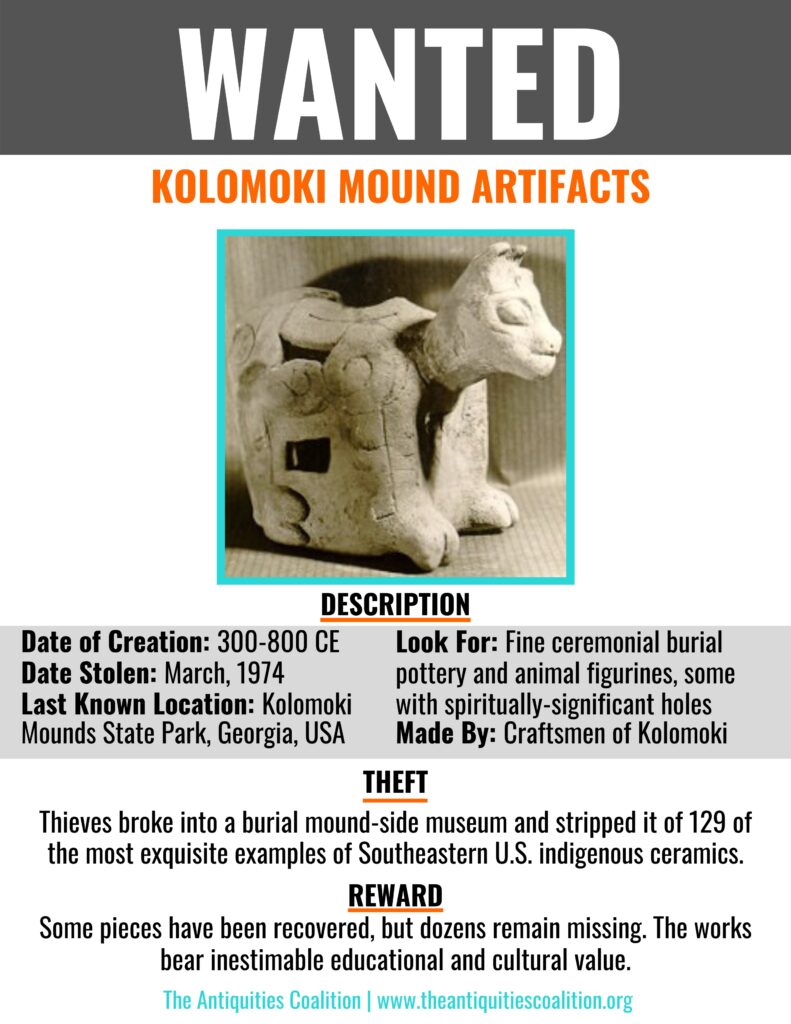
One of the “Ten Most Wanted” Antiquities Surfaces in Georgia After Half a Century

Anonymous Return of 1,500-Year-Old Native American Artifact Revives Cold Case from 1974 Heist 

Washington, DC, 12 May 2026—The Antiquities Coalition’s “Ten Most Wanted” List has reached a third milestone. An ancient ceremonial pottery vessel, one of over 120 pieces stolen from the Kolomoki Mounds State Park in Georgia more than five decades ago, has now been recovered. The Kolomoki mound artifacts, most of which remain missing, have been featured in the Antiquities Coalition’s campaign since it first launched in 2020 to find—and bring home—looted cultural treasures from around the world.

According to surveillance footage reviewed by the Atlanta Journal-Constitution, on April 8, a bald man in glasses entered the park’s visitor center, set a cardboard box on the counter, and told a staff member, “I believe this belongs here.” He then walked out without identifying himself. The Georgia Department of Natural Resources (DNR) says he is not considered a suspect in the original theft, but is asking for the public’s help in locating him.

The vessel had been missing since March 1974, when thieves pried open the back door of the visitor center and made off with more than 120 ancient artifacts, all that were on display at the time. Kolomoki Mounds, the oldest and largest Woodland-era Native American site in the southeastern United States, was built by peoples of the Swift Creek and Weeden Island cultures. DNR has said it plans to work collaboratively with federally recognized tribal partners on this artifact and any future recoveries.

“This is exactly why we created the Ten Most Wanted Antiquities List,” said Deborah Lehr, Chairman and Founder of the Antiquities Coalition. “When the public knows what has been stolen, recoveries become possible—even ones that have been impossible for fifty-two years. The Kolomoki vessel is the third piece from the list to be identified, and each one shows that public awareness can succeed where decades of investigation have stalled.”

The Kolomoki vessel joins two earlier successes from the Ten Most Wanted campaign: the recovery and return of a monumental 10th-century sculpture of the elephant-headed god Ganesha to Cambodia and the identification of the Kwer’ata Re’esu Icon of Ethiopia.

Anyone with information about the still missing Kolomoki artifacts—or other objects on the Antiquities Coalition’s Ten Most Wanted List—can submit tips, anonymously if preferred, to:

Antiquities Coalition Reveals the 2026 Looks vs. Loot

The Met says “Fashion is Art,” but is protecting art still in fashion?

On the first Monday in May, the steps of The Metropolitan Museum of Art (Met) serve as a pedestal for celebrities and cultural tastemakers, draped in the latest creations from the leading names in fashion. This year’s dress-code, “Fashion is Art,” fittingly celebrates the museum’s role as a steward of some of the world’s most significant artistic and cultural treasures. 

And yet, behind many of the masterpieces inspiring tonight’s looks are histories of colonial plunder, armed conflict, and organized crime.

The International Consortium of Investigative Journalists has identified more than 1,000 objects in the Met’s catalog tied to alleged traffickers and looters, few of which the museum has publicly addressed. Art is in fashion. Is accountability?

Against this backdrop, the Antiquities Coalition launches its fourth annual Looks vs. Loot campaign, in which we pair red-carpet looks with repatriated antiquities from the Met. Over the past year, the museum has continued to return contested objects, publicly announcing restitutions to countries including Greece, Italy, Spain, and Türkiye

In several of these cases, the Met has paired restitution with partnership. In September 2025, for example, the museum announced the return of a Sumerian Vessel Stand with Ibex, dating to circa 2600–2350 BCE, following in-house provenance research that determined it belonged to the Republic of Iraq. Alongside a repatriation ceremony, the Met and Iraq embarked on a collaborative research project, presenting restitution as an opportunity for shared international scholarship. 

However, the Met faces ongoing scrutiny over objects in its collection associated with alleged traffickers or with unclear provenance. The 2025 reopening of the Michael C. Rockefeller Wing, housing the Met’s collections from Africa, the ancient Americas, and Oceania, has prompted wider public discourse over the museum’s collections and curation, with some critics viewing the discussions of provenance research as deflective or performative.

The glamour of the Met Gala risks overshadowing the red flags the museum still hasn’t addressed. Transparency remains an ongoing challenge: public information on restituted objects is minimal and proves difficult to locate on the museum’s website. By disclosing restitution information and publishing regular data, the museum could better show that its commitment to addressing its collection is being matched by meaningful and proactive action.

Step aside, stars. It’s time to put institutional accountability center-stage.